Save a copy of this one. This paper received its funding from …SURPRISE… the Bill and Melinda Gates Foundation. Titled “Framework for a Multistate Human Capital Development Data System,” this paper outlines the population tracking of people in America. Here’s a few salient quotes.
The rise of a globalized knowledge economy requires us to understand the distribution of skills and abilities in our population.
This “human capital development data system” must be developed to answer “master” policy questions that benefit each of the principal state stakeholders – the K-12 education system, the postsecondary system, and labor/workforce development system– both for accountability purposes and to inform improvements in policy and practice.
A more effective data system for accountability and policy and practice improvements could provide answers to such questions. Integrated to enable large-scale longitudinal analyses to support state educational and workforce development policy, student or individual unit-record data, linked together across K-12 education, postsecondary education, and the workforce, comprise what we call a human capital development data system(HCDDS). An HCDDS should be able capable of: • Tracking the stock and flow of the skills and abilities (represented by education and training) of various populations within a given state. • Examining the gaps in educational attainmentbetween population groups, based on demography and socio-economic status. • Incorporating information from multiple states, given the mobility of the U.S. population and the fact that many population centers are located on state boundaries.
We are all cattle now.
Given the sensitivity of SSNs and the fact that even they cannot match all individual student records “perfectly,” it is probably wise for states to adopt a broader approach to “identity matching.” Such an approach would link records using a larger group of variables corresponding to student characteristics, including but not limited to the SSN (when available) or statewide student identifier.
Use of Social Security Numbers would pin all tracking data to an individual instead of aggregating it and protecting children’s privacy.
While there is still much work to be done in linking K-12 and postsecondary records, states also should be planning now for how to incorporate workforce data into their longitudinal data systems. Indeed, the federal government has made this a basic expectation for states receiving ARRA funds.
When Utah applied for federal money under Race to the Top and the American Reinvestment and Recovery Act (ARRA), the feds required us to sign onto a database to track students from preschool through college and into the workforce. Just a year ago the Utah State Office of Education announced their partner in a P20w statewide longitudinal database system that can integrate with other states and federal agencies. <sarcasm>All for research purposes of course.</sarcasm>
Some years ago, Outcome Based Education was shot down by parents when they awoke to what was really going on…the tracking of children and “master” planning for society based on creating good little trained monkeys for the workplace. Children are people. We need to stop treating them like widgets being stamped out at a factory.
Concerned yet? Share this with your legislators and ask them to get us out of Common Core and the Statewide Longitudinal Database System. IT’S NOT GOING TO BE USED JUST FOR RESEARCH. Share fliers with your neighbors. It’s time for an overhaul of our education system that brings it all in-state and gets us off the federal dollars.
Representative Rob Bishop addressed the Utah Senate and took some questions. Go to the 11:50 mark on this video and Senator Margaret Dayton asks him about Common Core. Watch to the end as there is another question asked and Rep. Bishop gives a very clear answer about states being hooked by the feds on Common Core.
Last night, in his State of the Union address, President Obama made a rather bold and unexpected statement about education.
He said, “Right now, countries like Germany focus on graduating their high school students with the equivalent of a technical degree from one of our community colleges, so those German kids, they’re ready for a job when they graduate high school…We need to give every American student opportunities like this.”
It was bold, because he laid out his vision for education in very clear terms. It was surprising, because he’s usually been more cautiously obscure about his intentions.
For months, opponents of the Common Core State Standards (CCSS) have been trying to show people that CCSS is being used by the Federal government to expand its role in education. The president helped us paint that picture last night.
Most states adopted the CCSS as part of the first Race to the Top (RTT) program, which Obama initiated in July 2009. He praised the results of the original program last night, saying, “Four years ago, we started Race to the Top, a competition that convinced almost every state to develop smarter curricula and higher standards.”
Then, in conjunction with his assertion that he wants the U.S. system to work like Germany’s, Obma proceeded to announce a second RTT program.
It appears that not only were the opponents of the CCSS right about increased Federal involvement, but that it goes even further than we’ve said. Based on Obama’s bold statement last night, the current thrust of education reform is toward a centrally-managed education system that assigns kids to tracks – like Germany. And a centrally-managed education system is part one of two parts to a centrally-managed economy, the other part being high government regulation of businesses.
How will this affect kids (and by extension, businesses) in Utah? That all depends on how our legislators and elected officials in the executive branch respond to the money that will be offered, and the nice-sounding promises that will be made.
We will either join the movement toward a German-style education system, lured by the siren song of educational utopia and the millions of dollars in the new RTT competition; or stand for basic American freedom, say “No” to the money, preserve our free markets, and protect our kids’ basic right to choose their own destiny, rather than be told what they are “best-suited for.”
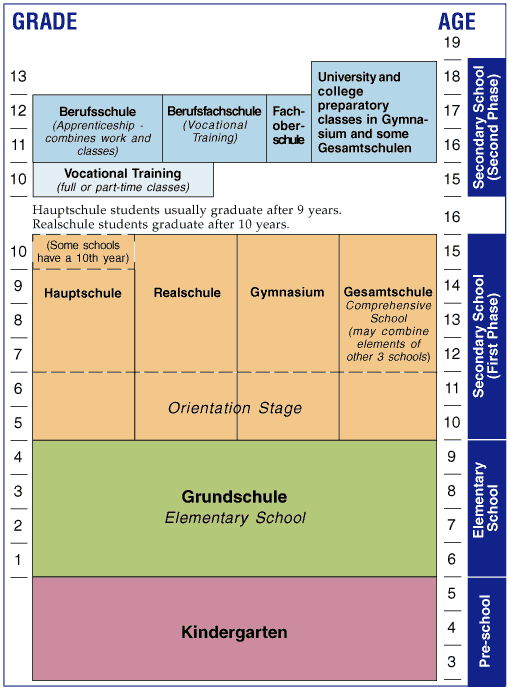
Obama’s statement was very clear: he wants our education system to look like Germany’s, where the test you take about the time you are 10 years old determines your future.
German Education Tracks
We in Utah need to be just as clear: we want no part of this system. While there are a few aspects of its system which are perhaps worthy of emulation, its disregard for individual liberty and undermining of the free market by projecting what jobs will be needed and slotting kids for them is not. We want no part of the Federal government’s promises of educational Eden, “if we’ll just let them be more involved and share our kids’ personal data with them.”
Education is not just about producing workers, which seems to be Obama’s attitude. It is about acquiring knowledge to enrich one’s understanding of the world, one’s appreciation for beauty, one’s understanding of the deep truths of humanity. Acquiring skills that enable one to seek employment in the occupation of his or her choice is an inevitable consequence of teaching for the former purposes.
And education is best handled entirely at the most local level. Utah’s elected officials should turn down the RTT bait, which will draw us into deeper dependence upon and accountability to the Federal government. They must remember and honor the basic principles of the American way of life while they formulate ways to strengthen our educational system.
One final item worthy of note: homeschooling is illegal in Germany. Does Obama aspire to imitate this feature as well?
What You Can Do: Contact your state representative and senator and tell them you’re concerned about the push to institute a German-style education system in the U.S., and that you want them to oppose bills that will move us in that direction.
Contact your state school board member and tell them you’re concerned about the push to institute a German-style education system in the U.S. Tell them that you want them to tell the State Office of Education not to apply for the new RTT grant, and get us out of Common Core.
Contact the governor and tell him you’re concerned about the push to institute a German-style education system in the U.S., and that you want Utah to get out of Common Core and not participate in the new RTT grant competition.
ADDENDUM TO ORIGINAL ARTICLE:
This was just passed on to me. The Obama administration is actively seeking to deport a German family who has refugee status in the U.S. because they homeschool, which is illegal in Germany. The Obama Justice Department says that the family should be promptly deported even though the children may be seized by authorities and the parents jailed if they are forced to return to Germany, because homeschooling is not a fundamental human right.
If you’ve been unaware of the intentions of this administration as regards the role and rights of parents, this story should make everything very clear. And it should increases concern about the new RTT program which seeks to advance Obama’s agenda for children.
Someone sent in this news report video and it’s confirmation of something we have repeated numerous times. Common Core requires states to set up a statewide longitudinal database to track children. Marc Tucker in the 90’s wrote Hillary Clinton desiring such a database to implement cradle-to-grave tracking of citizens for the purpose of central planning and school-to-work organizing. Now Rep. Maxine Waters confirms the presence of a massive database President Obama has put in place giving him information on every citizen in America. Listen to her alarming words.
Here’s the bulk of her quote:
“I think some people are missing something here. The president has put in place an organization that contains the kind of database that no one has seen before in life. That’s going to be very, very powerful.
That database will have information about everything on every individual in ways that its never been done before and whoever runs for president on the Democratic ticket have to deal with that, they’re going to have to go down with that database and the concerns of those people because they can’t get around it and he’s been very smart , I mean it’s very powerful what he’s leaving in place.” -CA Rep. Maxine Waters on TVone.tv interview
What do you get when corporate interests combine with governmental force to take over education? Nationalized educational and economic fascism. Thankfully, more legislators are starting to wake up to the situation.
E-mails link Bush foundation, corporations and education officials
A nonprofit group released thousands of e-mails today and said they show how a foundation begun by Jeb Bush, the former Florida governor and national education reform leader, is working with public officials in states to write education laws that could benefit some of its corporate funders.
…
The e-mails were obtained by Cohen’s group through public record requests and are available here, complete with a search function. They reveal — conclusively, he said — that foundation staff members worked to promote the interests of some of their funders in Florida, New Mexico, Maine, Oklahoma, Rhode Island and Louisiana.
The Web site of the Foundation for Excellence in Education used to list some of their donors but no longer does and is not required to list all of its donors to the public under tax rules for 5013C organizations. However, it is known that the foundation has received support from for-profit companies K12 and Pearson and Amplify, as well as the nonprofit College Board.
FEE and ALEC also have had some of the same “experts” as members or staff, part of the revolving door between right-wing groups. They have also collaborated on the annual ALEC education “report card” that grades states’ allegiance to their policy agenda higher than actual student performance. That distorted report card also rewards states that push ALEC’s beloved union-busting measures while giving low grades to states with students who actually perform best on standardized knowledge tests.
So a “non-profit” organization takes donations from companies that want to get in on the Common Core movement and then lobbies for changes to help those corporations get entrenched to make billions. It’s no wonder that ALEC has squashed their anti-Common Core model legislation twice after receiving a sizable donation from the Gates Foundation. You can get all the power and control you want for money and Gates has already spent well in excess of $100 million to promote Common Core and fulfill the contract he signed with UNESCO in 2004 to create a global education system.
Pressure Mounts in Some States Against Common Core
Support for the standards from the private sector and higher education is clear, said Michael Cohen, the president of Achieve, a Washington nonprofit group that helped develop the standards and now helps state governments and others prepare for the common core and its assessments.
“These standards reflect the knowledge and skills needed to go on for higher education and careers,” said Mr. Cohen, who was an assistant education secretary during the Clinton administration.
But the private sector’s involvement and support are seen very differently by opponents of the standards.
Through the common core, public schools will be used to foster “economic fascism” in education, charged former U.S. Rep. Bob Schaffer, a Republican from Colorado, who until the start of this year served as the chairman of the Colorado state school board before he left the board.
“This is a 100 percent government-regulated industry emerging before our eyes,” with potentially billions of dollars being sent in its direction, said Mr. Schaffer, who is the principal of Liberty Common High School, a charter school in Fort Collins, Colo.
Legislators previously desperate for federal cash attached to the standards, he said, are “just becoming alerted to what’s going on.”
Economic fascism is right. The corporate interests in America created Common Core. There was nothing “state led” about it. In Utah we have Prosperity 2020 which is working to influence education “success” according to how they want to define it. Isn’t it time parents and children define their own education success according to their own family standards? Prosperity 2020 wants more money for education to come from Utah taxpayers.
One of the comments at the end of the news article was from Ronald Mortensen where he said:
The business leaders behind Prosperity 2020 are always for more taxes as long as the incidence falls on individuals and not on them. Notice that there is no recommendation to increase the corporate tax rate, no proposal to eliminate sales tax exemptions for businesses and no call for the repeal of the business tax breaks that these business leaders have lobbied for and obtained during the past decade.
The Salt Lake Chamber is a leader in this effort and it is no coincidence that it has been designated by Americans for Tax Reform as an “Enemy of the Taxpayer.”
The Utah State Office of Education touts their involvement in the “state led” standards, yet they didn’t even know who was writing them. We’ve adopted math and English, and now the science and social studies standards are being written, and again, nobody knows who is writing the social studies draft standards.
Common Core Social Studies Standards? (I strongly suggest you read this article in its entirety)
In November 2012 the CCSSO released Vision for the College, Career, and Civic Life (C3) Framework for Inquiry in Social Studies State Standards. They say they are developing a framework for states to use as a resource as they upgrade their social studies standards and that this will not be a set of standards for states to adopt. They also say this framework is “being developed through a state-led effort”. They contend this framework, like the common core state standards, “will be based on evidence and will aim at college and career readiness.” The CCSSO is not disclosing the names of people on the writing team and tightly controls information about how and what business is being conducted.
I was told by 2 state school board members a while back that we would never adopt common science and social studies standards, just the math and English, yet just a couple weeks ago, state school board member Dixie Allen wrote Christel Swasey and said this:
Christel,
As one of my constituents, I owe you a response to your question. My New Year’s resolution is to work to be sure that our Core Curriculum contains all the objectives necessary to be sure our students are Career and College Ready as they leave our system of education. That will require our readdressing our Social Studies and Science Curriculum and evaluate if there are any issues with our current Core Curriculum in Math and Language Arts that needs additions or tweaks. This is a constant job of the State Board and our specialists at USOE. However, it is a very worthwhile assignment that truly needs to happen on a continuous basis, as our students change and require different methods of instruction and sometimes different learning objectives to insure they are ready for the 21st Century of higher education and work and are capable of competing on the world’s stage.
Thanks for asking!
Dixie
************
It’s only a matter of time before the noose tightens and states realize they’ve lost any hope of preserving local control of education for their citizens. Contact your legislators and ask them to get us out of Common Core. We can do better and preserve our freedom and sovereignty.
No more decisions behind closed doors! Let’s get everyone talking about Common Core.
In the spring of 2011 I received a receipt for the sale of my children. It came in the form of a flyer that simply notified me that my state and thereby my children’s school would comply with the Common Core. No other details of the transaction were included. The transaction was complete, and I had no say. In fact, it was the very first time I’d heard about it.
I know what you’re thinking. That’s outrageous! Common Core has nothing to do with selling things, especially not children!
Okay, so the idea that the State School Board and Governor who’d made this decision could be described as “selling” my children is hyperbole. It is an exaggeration intended to convey an emotion regarding who, in this land of the free, has ultimate authority over decisions that directly affect my children’s intellectual development, privacy, and future opportunities. It is not even an accurate representation of my initial reaction to the flyer. I say it to make a point that I didn’t realize until much, much later… this isn’t just an issue of education, but of money and control. Please allow me to explain.
That first day my husband picked up the flyer and asked me, “What is Common Core?” To be honest, I had no idea. We looked it up online. We read that they were standards for each grade that would be consistent across a number of states. They were described as higher standards, internationally benchmarked, state-led, and inclusive of parent and teacher in-put. It didn’t sound like a bad thing, but why hadn’t we ever heard about it before? Again, did I miss the parent in-put meeting or questionnaire… the vote in our legislature? Who from my state had helped to write the standards? In consideration of the decades of disagreement on education trends that I’ve observed regarding education, how in the world did that many states settle all their differences enough to agree on the same standards? It must have taken years, right? How could I have missed it?
At first it was really difficult to get answers to all my questions. I started by asking the people who were in charge of implementing the standards at the school district office, and later talked with my representative on the local school board. I made phone calls and I went to public meetings. We talked a lot about the standards themselves. No one seemed to know the answers to, or wanted to talk about my questions about how the decision was made, the cost, or how it influenced my ability as a parent to advocate for my children regarding curriculum. I even had the chance to ask the Governor himself at a couple of local political meetings. I was always given a similar response. It usually went something like this:
Question: “How much will this cost?”
Answer: “These are really good standards.”
Question: “I read that the Algebra that was offered in 8th grade, will now not be offered until 9th grade. How is this a higher standard?”
Answer: “These are better standards. They go deeper into concepts.”
Question: “Was there a public meeting that I missed?”
Answer: “You should really read the standards. This is a good thing.”
Question: “Isn’t it against the Constitution and the law of the land to have a national curriculum under the control of the federal government?’
Answer: “Don’t you want your kids to have the best curriculum?”
It got to the point where I felt like I was talking to Jedi masters who, instead of actually answering my questions, would wave their hand in my face and say, “You will like these standards.”
I stopped asking. I started reading.
I read the standards. I read about who wrote the standards. I read about the timeline of how we adopted the standards (before the standards were written.) I read my state’s Race to the Top grant application, in which we said we were going to adopt the standards. I read the rejection of that grant application and why we wouldn’t be given additional funding to pay for this commitment. I read how standardized national test scores are measured and how states are ranked. I read news articles, blogs, technical documents, legislation, speeches given by the US Education Secretary and other principle players, and even a few international resolutions regarding education.
I learned a lot.
I learned that most other parents didn’t know what the Common Core was either.
I learned that the standards were state accepted, but definitely not “state led.”
I learned that the international benchmark claim is a pretty shaky one and doesn’t mean they are better than or even equal to international standards that are considered high.
I learned that there was NO public input before the standards were adopted. State-level decision makers had very little time themselves and had to agree to them in principle as the actual standards were not yet complete.
I learned that the only content experts on the panel to review the standards had refused to sign off on them, and why they thought the standards were flawed.
I learned that much of the specific standards are not supported by research but are considered experimental.
I learned that in addition to national standards we agreed to new national tests that are funded and controlled by the federal government.
I learned that in my state, a portion of teacher pay is dependent on student test performance.
I learned that not only test scores, but additional personal information about my children and our family would be tracked in a state-wide data collection project for the express purpose of making decisions about their educational path and “aligning” them with the workforce.
I learned that there are fields for tracking home-schooled children in this database too.
I learned that the first step toward getting pre-school age children into this data project is currently underway with new legislation that would start a new state preschool program.
I learned that this data project was federally funded with a stipulation that it be compatible with other state’s data projects. Wouldn’t this feature create a de facto national database of children?
I learned that my parental rights to deny the collection of this data or restrict who has access to it have been changed at the federal level through executive regulation, not the legislative process.
I learned that these rights as protected under state law are currently under review and could also be changed.
I learned that the financing, writing, evaluation, and promotion of the standards had all been done by non-governmental special interest groups with a common agenda.
I learned that their agenda was in direct conflict with what I consider to be the best interests of my children, my family, and even my country.
Yes, I had concerns about the standards themselves, but suddenly that issue seemed small in comparison to the legal, financial, constitutional and representative issues hiding behind the standards and any good intentions to improve the educational experience of my children.
If it was really about the best standards, why did we adopt them before they were even written?
If they are so wonderful that all, or even a majority of parents would jump for joy to have them implemented, why wasn’t there any forum for parental input?
What about the part where I said I felt my children had been sold? I learned that the U.S. market for education is one of the most lucrative – bigger than energy or technology by one account – especially in light of these new national standards that not only create economy of scale for education vendors, but require schools to purchase all new materials, tests and related technology. Almost everything the schools had was suddenly outdated.
When I discovered that the vendors with the biggest market share and in the position to profit the most from this new regulation had actually helped write or finance the standards, the mama bear inside me ROARED!
Could it be that the new standards had more to do with profit than what was best for students? Good thing for their shareholders they were able to avoid a messy process involving parents or their legislative representatives.
As I kept note of the vast sums of money exchanging hands in connection with these standards with none of it going to address the critical needs of my local school – I felt cheated.
When I was told that the end would justify the means, that it was for the common good of our children and our society, and to sit back and trust that they had my children’s best interests at heart – they lost my trust.
As I listened to the Governor and education policy makers on a state and national level speak about my children and their education in terms of tracking, alignment, workforce, and human capital – I was offended.
When I was told that this is a done deal, and there was nothing as a parent or citizen that I could do about it – I was motivated.
Finally, I learned one more very important thing. I am not the only one who feels this way. Across the nation parents grandparents and other concerned citizens are educating themselves, sharing what they have learned and coming together. The problem is, it is not happening fast enough. Digging through all the evidence, as I have done, takes a lot of time – far more time than the most people are able to spend. In order to help, I summarized what I thought was some of the most important information into a flowchart so that others could see at a glance what I was talking about.
I am not asking you to take my word for it. I want people to check the references and question the sources. I am not asking for a vote or for money. I don’t expect everyone to agree with me. I do believe with all my heart that a decision that affects the children of almost every state in the country should not be made without a much broader discussion, validated research, and much greater input from parents and citizens than it was originally afforded.
If you agree I encourage you to share this information. Post it, pin it, email it, tweet it.
No more decisions behind closed doors! Let’s get everyone talking about Common Core.
The Home School Legal Defense Association issued a statement a couple weeks ago against the Common Core effort which they view as dangerous to the home school movement. Here is their statement:
December 17, 2012
Common Core State Standards Initiative: Too Close to a National Curriculum
William A. Estrada, Esq. Director of Federal Relations
Background
In 2010, the National Governors Association published their “Common Core State Standards” (CCSS). These were meant as voluntary math and English guidelines which individual states could adopt.
HSLDA and numerous other organizations grew concerned about this push to standardize what public school students are taught. HSLDA wrote two articles outlining our concerns, one in March of 2010, and one in June of 2010. We explained that states were being enticed by the federal government—through the Race to the Top program—to align their state curriculum with the CCSS, resulting in de facto national standards. We were concerned that this would lead to a national curriculum and national test, and that the pressure would grow for homeschool and private school students to be taught using this national curriculum.
During President Obama’s 2012 State of the Union speech, the president stated, “We’ve convinced nearly every state in the country to raise their standards.” How were the states convinced to adopt the CCSS? The simple answer—federal dollars. President Obama added adopting the CCSS as a criterion for states to gain points in the Race to the Top education federal grant program, regardless of whether the state already had comparable or superior educational standards. States with the highest points are more likely to win the competitive Race to the Top federal grants.
Forty-five states and the District of Columbia have adopted the CCSS since 2010. Only Alaska, Minnesota, Nebraska, Texas, and Virginia have not.
Are the Common Core State Standards a Good Idea for Public Schools?
Recently, there has been a growing controversy over whether the CCSS are even beneficial. Many states have spent years adopting their own state standards, only to throw them away in favor of the CCSS. Some commentators have said that the CCSS will weaken English learning and reduce analytical thinking. Others point to a weakening of math teaching. Still others point out that the CCSS will cost billions of dollars to implement—which could be deal-breaker for states struggling to implement the standards.
The CCSS by themselves are not necessarily controversial. They’re similar in certain respects to other state curriculum content standards for public schools. However, HSLDA believes that children—whether homeschooled, private schooled, or public schooled—do best when parents are fully engaged. And parents are most engaged when they know that they are in charge of their child’s education. Top-down, centralized education policy does not encourage parents to be engaged. The CCSS removes education standards from the purview of state and local control to being controlled by unaccountable education policy experts sitting in a board room far removed from the parents, students, and teachers who are most critical to a child’s educational success.
Will the CCSS Affect Homeschools?
The CCSS specifically do not apply to private or homeschools, unless they receive government dollars (online charter school programs have no such protection). However, HSLDA has serious concerns with the rush to adopt the CCSS. HSLDA has fought national education standards for the past two decades. Why? National standards lead to national curriculum and national tests, and subsequent pressure on homeschool students to be taught from the same curricula.
The College Board—the entity that created the PSAT and SAT—has already indicated that its signature college entrance exam will be aligned with the CCSS. And many homeschoolers worry that colleges and universities may look askance at homeschool graduates who apply for admission if their highschool transcripts are not aligned with the CCSS.
HSLDA believes that a one-size-fits-all approach to education crowds out other educational options, including the freedom of parents to choose homeschools and private schools. A common curriculum and tests based off common standards could be very harmful to homeschoolers if their college of choice refuses to accept a student’s high school transcript if it is not based on the CCSS. Homeschoolers could also have trouble on the SAT if the test is fundamentally altered to reflect only one specific curriculum. And our greatest worry is that if the CCSS is fully adopted by all states, policy makers down the road will attempt to change state legislation to require all students—including homeschool and private school students—to be taught and tested according to the CCSS. Common Core State Standards spreading
The National Governors Association first focused the CCSS on the general subject areas of math and English. However, there is now movement to create CCSS in numerous other subject areas. The National Governors Association is also urging states to align early education programs for young children.
Due to laws prohibiting the creation of national tests, curriculum, and teacher certification, governors and state legislatures are the only policy makers who can actually decide whether or not to adopt the CCSS. While the federal government has encouraged the states to adopt the CCSS through federal incentives, the states are completely free to reject the CCSS.
Further Action
To find out whether your state has adopted the Common Core State Standards, you can visit this website’s useful map. (Please note that this is the website for the common core state standards initiative.)
Contact your state legislators, including the governor, to discuss this issue with them. Ask them about their position on the issue. Find your governor’s current information here.
If you have a governor’s election coming up in your state, we encourage you to raise this issue with the candidates. Even if a state has already adopted the national education standards, a new governor will be faced with the costs of implementing these new standards and new accountability to the federal government.
Numerous states that have already adopted the CCSS are considering rejecting the CCSS. Now is the time to help raise awareness of this issue and educate yourself about the CCSS.
Because this affects all parents, and will not currently affect homeschool freedom, it is not necessary to identify yourself as a homeschooler.
I received this email yesterday and (with permission from Sue to post) thought I would pose the question to parents, do you know what’s in your child’s school books?
Oak,
I just thought you would be interested and I want to let as many parents as possible aware of my experience. I have been a homeschooling mom mostly since my now 17 year olds were in 3rd grade. We recently moved to Springville and that combined with other circumstances led me to try public school for all my 7 kids who are of school age (I have 2 younger ones still at home.)
It has a positive experience so far in many ways but I continue to dislike common core on many levels and I have really been concerned about what is and isn’t being taught in history. So concerned that I decided to ask my 6th grade child’s teacher if I could borrow a copy of the history books he is teaching out of.
Appalled is the ONLY word I can think of to describe what I found there! It’s a world history book and the section on the US is maybe 4 pages long. It has no mention of our founding fathers but teaches abundantly about Karl Marx and his “wonderful ideas”.
The section on Christianity is a joke but the section on Islam is lengthy. It’s just ridiculous! !
Needless to say my kids will either be transferring to the local charter school that does not use common core and teaches much about our founding fathers or it’s back to homeschooling.
I think the media needs to hear about this! Just thought you’d be interested.
Thanks, Sue Schmidt
Do you want to be a solution to problems? Speak up to teachers, principals, and your school board. I recently filed a GRAMA request with the state and in correspondence with the legal council for the Utah State Office of Education, I was told the request was going to be charged to me because they felt it was primarily of private interest instead of public since state board members had not received a single complaint on the subject of the selection of the new superintendent. I happened to know this was false but this is how things work. If you don’t speak up, those who do get more easily isolated. It reminds me of a few years ago when in the course of a single month, I was contacted by 4 separate families who went to Alpine School District to complain about Investigations math, and the very same administrator at the district office told each one of them that they were the only parent to ever complain about the math program. Each left wondering if they were the only one to speak up. Unless we all speak up about the problems and work to get our neighbors informed and to do it as well, we will continue the downward slide into government controlled curriculum and indoctrination. I am so thankful for those of you that do speak up in meetings, emails, and phone calls. Please keep pressing forward.
I received this email below from someone in the Midwest showing the direction the Academy of Science wants to take teachers in STEM fields. STEM is Science, Technology, Engineering, and Math. STEM is being pushed hard in Utah and other states because there is a very real shortage of math literate students. The problem is, pushing the Green movement as they are below, won’t help math skills improve. If we really wanted to solve the math problem, we would cut constructivism out of schools since it’s a proven failure, and implement real math programs. That would solve the STEM problem by giving children a solid foundation in math and their success would drive their career choices.
Another link someone else sent me this morning shows what UNESCO is planning for teacher professional development. This verifies that this green movement push is all about the “sustainability movement” which is going to be used to control populations.
This comes as no surprise to those of us following the trail of Common Core. Common Core is being hijacked by the Feds and UNESCO to push the sustainability movement. For an excellent video showing this problem, please watch Alisa Ellis’ presentation at the recent Agency Based Education conference. Then write your new Utah legislators and ask them to get us out of Common Core because of it’s direct ties to movements against our freedom and sovereignty.
(sorry for the poor formatting below)
Free, FUN, informative and interactive Science Careers Explorations with STEM professionals for students in Grades 6 – 8.
Teachers apply soon! Space is limited!
WHO?
Groups of 20 – 25, 6th – 8th grade students. The program can accommodate four groups of 20 – 25 students per day. Individual students are welcome, but must register and be accompanied by a parent or guardian.
WHERE?
Missouri Botanical Garden Commerce Bank Education Center 4651 Shaw Boulevard, St. Louis, MO 63110 (NE corner of Shaw and Kingshighway)
WHEN?
January 23 (Room for 75 students) January 29 January 31 February 5 (Room for 75 students) February 7 (FULL) February 13 February 22 (FULL) Program is from 9 am – 1 pm each day.
Pick one or more available dates. NOTE: Dates are available on a first-come, first-serve basis.
HOW?
If you would like to select a group, or groups, of 20 – 25 6th, 7th, and/or 8th grade students to participate in Greening Your Future, please REGISTER HERE, or contact program director, Rose Jansen at 314-537-7889, or rjansen@academyofsciencestl.org.
PLEASE PROVIDE: The date/s you would like to attend, the name and address of your school, grade level/s to attend, number of students per grade level group, and the name and contact information (school, cell, home phone numbers and email addresses) of the teacher chaperone/s and school principal.
Greening Your Future is a Science Careers Exploration initiative of The Academy of Science – St. Louis.
Greening Your Future is a high-impact and informative science careers program that introduces students to real-world science and and possibilities of future science careers.
Each session during the program puts students in touch with working scientists, engineers and STEM professionals to explore careers in science through interactive and hands-on demonstrations. Students experience the interdisciplinary nature and impact of science today.
BRING: sack lunches and drinks for students, teachers and chaperones on the day of the program. Sharpened pencils.
Limited funding may be available for bus transportation. Contact program director, Rose Jansen at 314-537-7889, or via email.
A couple weeks ago at the Agency Based Education Conference, Alisa Ellis spoke on the subject of tying Common Core to its global origins. Here is that presentation. I encourage you to share this with everyone you can, especially legislators. This offers the connections that tie Common Core to Agenda 21 and UNESCO.




 Teachers apply soon! Space is limited!


