Utah Gov. Gary Herbert, a Republican, supports the concept but said his state is cautious about federal encroachment.
“Common Core was designed initially by the states,” Herbert told TheBlaze. “It’s really just a common goal. It predates my time. Governors were upset about the progress of education. We’re falling behind. So states simply said, ‘Why don’t we have a common goal on language arts and math, and whoever you are in this country, when it comes to getting a high school diploma, you have some kind of minimal proficiency?’ That aspect of it was good.”
“We certainly don’t want to have the government overreaching and dictating to the states, certainly not to Utah, about our methodology, how we’re going to do it, what our textbooks are, what our testing is going to be,” Herbert said.
“In fact in Utah, we’ve passed a law to say that can’t happen. We have a law that says if any of this federal overreach somehow gets into our system, we are mandated to get out of it. I think our education, our state school board, our education leaders, we’ve always controlled our own curriculum, we’ve always controlled our own textbooks and testing. We’ll continue to do that in Utah.”
Here are some specific issues with his statements:
1) Common Core was not initially designed by the states. The common national standards movement has been around for decades. David Coleman, architect of Common Core, has clearly stated that he went around convincing governor’s to sign on. This was done long before the states got involved.
2) Minimal proficiency is one thing, but due to the amount of testing and tying this to teacher performance, Common Core is maximum standards, not minimal. Teachers don’t have time to do anything else. I spoke with a teacher this weekend who supports Common Core, and said she no longer has time to teach her elementary students history or art or read to them because of all the stuff she has to cover. The amount of testing has doubled and there is no time to individualize education for her students. She said all the teachers in her school are frustrated by this, and she SUPPORTS Common Core.
3) The law: SB 287 is what the Governor is referring to. I’m well familiar with this law because I wrote the draft. I put specific triggers in the bill that if any of a number of things happened, this bill mandated that “Utah shall exit Common Core.” When it got introduced, the language had mysteriously been change from “shall exit” to “may exit,” supposedly by the governor’s office request. The teeth had been removed from the bill and now it is essentially inert. Instead of “This is Utah and if you do that we’re gone!,” it’s “Yeah, so what, we might exit if we really feel like it.” Here’s a link to the bill. Line 53 is the neutered line.
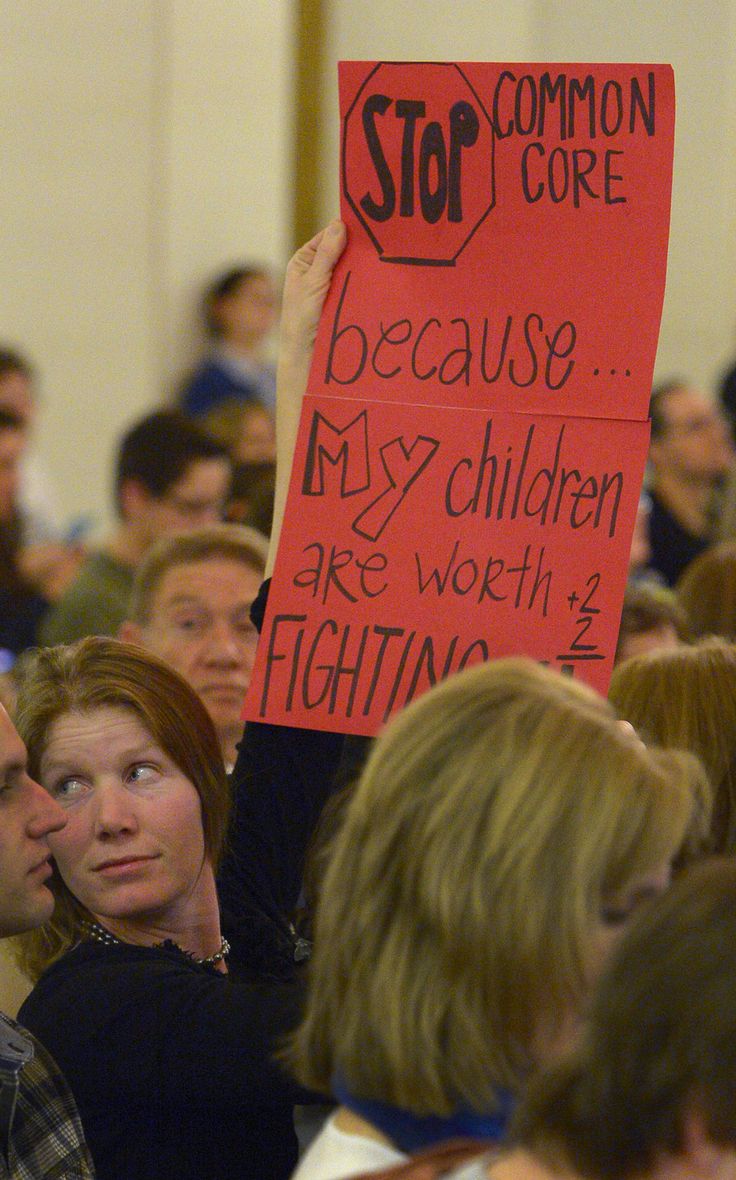
On 2/18/2014, a large crowd of about 500 people from all over Utah gathered in the state capitol for a rally to restore local control to Utah. Speakers included legislators, essay contest winners, and representatives from various organizations. Here is the video from the rally. We had some audio issues with the speakers from the capitol and I think I edited out all the problems so you’ll know if you see a skip here or there.
Donna Garner recently sent me this email containing what she called English Success Standards.
“Oak, attached are the English Success Standards. This document is free for the taking, and any and all may use whatever out of this document they so choose. There is no copyright or attribution necessary. This document is the only standards document in the entire U. S. that was written by classroom teachers for classroom teachers. The writers of this document were all practicing classroom teachers at the time they wrote their document.”
Did you catch that? Practicing teachers wrote them, not non-practicing, non-teachers like David Coleman, architect of Common Core. They are developmentally appropriate and high level.
If you want to read an analysis on these standards, read here. Download link is below.
A year ago, Dr. Sandra Stotsky, a long time critic of Common Core standards, released an ELA framework for use in schools, districts, and states, for free. Dr. Stotsky is well known for her participation in crafting the excellent 2001 ELA standards for Massachusetts and how those standards eventually ranked MA as one of the very best states in the country on standardized tests. She revised these standards and released them for free as well.
If you are new to this site, please make it a priority to read this post on what valid high quality alternatives we have to Common Core. This link contains both math and ELA information, but I will briefly summarize our high-quality ELA standards options below.
Three awesome options at the best price available. Free.
I recommend you download a copy of Dr. Stotsky’s 2013 standards for safe keeping, and then let legislators know there is a free set of standards Utah could adopt that would make us the envy of the nation in a short time.
Imagine Utah having the best standards in the nation, and teachers free from the red tape, data tracking, etc…, free to teach children and look at the needs of the individual instead of the collective. Keep that vision and get on the email list at www.AgencyBasedEducation.org. It’s a very low volume email list for an organization with a unique vision of education.
The last of our essay contest winners, public school teacher Cami Isle, had laryngitis on Tuesday so her husband presented her essay at the rally on Tuesday night.
by Cami Isle
I am a mother and a teacher at a local charter school. I am an aunt and a friend. The children in my life deserve better education than these standards can provide. From the time that I found out about Common Core, a fire has been lit in my veins. I feel with the utmost sincerity that I must fight this with everything I have in me.
I have heard many, even in my own family, claim that these standards are a good thing – that they will help our children have higher educational standards so that they can be more competitive in the world. I have heard teacher friends defend Common Core as if I had attacked them personally. But, I have also heard many voice their concerns about the intrusiveness of the testing and data sharing. I have heard the frustration of students who can’t understand what is being taught using these new and untested methods. I have witnessed the light and excitement of learning being snuffed out of those young people because there is now so much testing pressure, they have no more class time for things like art or music.
I believe that change happens at a local level, by those who are closest to the issues at hand. Parents, teachers and principals have always been the foundation of a good education. And each state has had the ability to make changes based on the needs and desires of their residents. With CCSS and other federal over-reaches, that control has been stripped away, leaving parents with no way to advocate for their children. Worse, good teachers are robbed of their creativity and joy as they must follow strict guidelines and benchmarks instead of having the freedom to teach what their students are ready to learn.
The standards are only a part of my problem with Common Core. My blood boils to know that what was once protected information about students and their families is now available to private companies and government officials. Our children are being used as lab rats so that these companies can view them as “human capital”.
Teaching has never been, nor should it ever be, “efficient”. Children are individuals. They learn in unique ways, have unique interests, and progress at their own paces. There is no possible way to take such diverse individuals and make them fit a one-size-fits-all way of learning and doing things. That is the joy of teaching – to take such a beautifully different group of people and help each one fill his or her potential.
I will take it one step further. I not only oppose the Common Core State Standards, I have my own ideas for what could be done to improve education for our children – the future of this great Nation. I believe that we should have MORE choices, not less. From Charter Schools, private schools, home schools and regular public schools, each parent should be able to choose what fits their student the best. Compulsory education should be a thing of the past. We all know of many brilliant people throughout history for whom the public schools failed. With things going the way they are, the CCSS will effect all of those educational choices negatively.
I also think there should be MORE voices, not less. The censoring that has gone on in forums where Common Core is being discussed is ridiculous. We need to hear all ideas, not just the ones we agree with. It is only in truly listening to all points of view that the best solutions can be met.
Deseret News and Salt Lake Tribune reporters attended the Utah rally; read their reports here and here.
Here’s my short version of the events.
Representative Brian Greene spoke about fairness and transparency in state school board elections. His new bill that can create it: House Bill 228. He asked Utahns to please write to the representatives and ask them to help push that bill out of committeeso legislators may vote on it.
Representative Dana Layton spoke about her bill to restore local control of education, House Bill 342. She quoted Diane Ravitch’s words about Common Core from the speech/article “Everything You Need To Know About Common Core.”
State Senator Margaret Dayton spoke about the need for informed citizens and for a return to local control and away from Common Core.
Psychotherapist Joan Landes spoke about the psychological devastation that the age-inappropriate Common Core and its experimental testing wreaks on students.
Three essay winners read their essays and won boxes of Mrs. Cavanaugh’s chocolates: Brian Halladay, a member of the Alpine School Board; Amy Mullins, a teacher; and Cami Isle, a teacher. All the essays that were entered into the contest will be posted at Utahns Against Common Core.
I got to introduce these three writers, and got to explain why we held the essay contest. In the spirit of restoring legitimate learning and the joy of reading and writing, Utahns Against Common Core aimed to model the practice of written human conversation and critical thought –which happens in personal essays.
Common Core doesn’t encourage personal writing. It prefers technical writing and info-texts. In fact, David Coleman, lead architect of Common Core, explained why he ditched personal writing: ““As you grow up in this world you realize that people really don’t give a !% #*^about what you feel or what you think… it is rare in a working environment that someone says, ‘Johnson I need a market analysis by Friday but before that I need a compelling account of your childhood.’ ” Coleman mocks personal writing and slashed it, as he also slashed the allowable amounts of classic literature, starting in elementary grades at just 50% but cutting more and more– until, as high school seniors, students must devote 70% of their readings to informational texts, allowing only 30% to be fictional stories, the stuff that makes us love reading in the first place. (Excuse me while I pull out my hair and scream.) So. Since Coleman mocks the personal essay and works to incrementally delete classical literature, we must work to restore them.
This is why we held the essay contest.
After the essay readings, teacher and author Sinhue Noriega spoke about Common Core being much more than just standards, and also being –despite proponents’ claims to the contrary– a curriculum; and he spoke about the unconstitutionality of the Common Core.
Attorney Ed Flint spoke about the Common Core-related law suit in which he is involved. Details here.
Radio host Rod Arquette spoke passionately, telling the story of how the Seattle Seahawks won the Superbowl this year in part because of the athlete who often asked the team, as his father had often asked him, “Why not you? Why not us?” Arquette turned the question to the audience. Why can’t we change the course of the Common Core? Why not us?
Representatives from the Left-Right Alliance, Libertas Institute, Utahns Against Common Core, FreedomWorks, and several other organizations spoke for just one minute apiece.
Dad Oak Norton closed the meeting with a solemn call to action.
The words that stayed in my mind more than anything else from the evening were the words of retired Judge Norman Jackson’s opening prayer. These deserve to be remembered and pondered.
Judge Jackson prayed:
“Dear God and Father of us all,
We express our Gratitude for the time, means and opportunity to gather this day at the seat of our Government. We acknowledge our firm reliance on Thy Divine protection and guidance in all the affairs of life. And ask Thy forgiveness of our trespasses as we forgive those of others. Enable us to live with charity for all.
We thank Thee for the endowment of unalienable rights – including life, liberty and the education of our children. May our land, schools and homes be places of light, liberty and learning. Bless us and all citizens with the desire to be governed by correct principles. Bless those who govern with that same desire.
Protect parents, children and teachers from the designs of conspiring men and women. And from the pretensions of those who occupy high places. Preserve the sanctity of our homes from the decay of individual responsibility and religion. Stay the hands of those who would harm and offend our children. Grant us and all citizens the strength to be eternally vigilant in this great cause.
Bless the proceedings and participants of this gathering with Thy guiding influence and sustaining care. Bless us and our children with Thy holy light – we humbly pray in the name of Thy Son Jesus Christ. Amen.”
Another of the 3 winners in our essay contest, Amy Mullins presented this essay at the rally on Tuesday night.
You Cannot Standardize the Human Spirit
by Amy Mullins
As a parent, a former educator, and a citizen of Utah, I am unequivocally in favor of excellence and rigor in Utah’s public school system. Utah has a long history of providing high-quality education for our children. I applaud efforts to continue and improve upon that tradition. But those efforts need to be concentrated at the local level and focused on the individual needs of children. Common Core, rebranded here as Utah Core, with its accompanying testing, its longitudinal data tracking, and its one-size-fits-all approach, misses the mark.
We are turning over our education system to committees and think tanks, publishing houses, and assessment companies. Decisions about our students are being made in boardrooms instead of classrooms. We are missing out on one of our greatest resources when we take teaching out of the hands of our teachers. We are told teachers can select their own curriculum, but they have no control over the content of the assessments for which they are accountable. Do we judge a physician on the outcome of a single surgery? Or a lawyer on the verdict of a single case? Or our legislators on the passage of a single bill? Of course not! That is ridiculous! Yet our schools and teachers will be evaluated on the outcome of a single test.
As if demoralizing our teachers isn’t enough, this testing culture serves
is dehumanizing our children and stripping them of their individuality. We expect them to be automatons that think and learn alike. When we decree that all children of the same age must acquire the same skill set at the same time in the same manner, we lose sight of the unique child. We ignore the child with special needs who requires extra time and accommodations. We sacrifice the bright child who is ready to move farther and faster than the prescribed standards dictate. When we let a computer adaptive test tell us if children have sufficiently met those standards, we are giving the power to the test makers at the expense of the test takers.
We cannot allow our children to be reduced to a score or a composite of data points. No standardized test can measure the curiosity, creativity, passion, ingenuity, or potential of the human spirit. No data from a computer can predict the intellect of an Einstein, the vision of a Walt Disney, the innovation of a Thomas Edison, or the passion of a Mozart. No amount of testing, measuring, or tracking of my child is going to determine what he will achieve.
I am for excellence in education. But I do not believe it will be found in assessments or computer data banks. Common Core is not the answer. True excellence is best accomplished in the hands of skilled teachers who are dedicated to their students, in the minds of local leaders who know the needs of their districts, schools, and communities, in the hearts of parents who want the very best for their children, and in the souls of those unique, wonderful children who are the future of Utah.
Be sure to read the comments at the bottom of this article from teachers. Teachers have been afraid for their jobs. I spoke with one yesterday in Southern Utah who said almost all the teachers in his school don’t like Common Core but they are nervous about saying anything that could put their job in jeopardy. Lets hope the NEA finally wake up a bit.
Here’s one teacher’s story from the comments:
Moby Jones says: “I am beginning to hate my job. I hear in my district, “implement the Math Common Core this year. No, we cannot afford any new materials or texts. We want you to struggle through this process and create your own so you can become expertly familiar with the new standards. Oh, and yes, your value add score might show you are a ‘least effective teacher’ and next year your salary will be tied with your value add score. You are now under the guise of the PARCC Consortium and next year your kids will be taking the PARCC tests. This year, on top of state assessments, you also must have your kids take MAP tests 3 times per year, a Measure of Academic Progress. Heavens, no, you don’t know what the test items are! But we’ll send you your kids’ scores to see how well you’re all doing”. As I said, I’m beginning to hate my job. We are told we must do anything and everything to get our kids to pass these tests, especially those “subgroups” that notoriously don’t pass. We must do anything and everything; we change things mid-year and try something new. We shift on a whim. Why aren’t you growing these kids? Their projected scores say they should be at this number, but they’re not. I am not very effective. After almost 30 years, I am beginning to hate my job.”
This post aims to be as unmistakably direct and documented as possible. Feel free to use it without asking permission.
DOES COMMON CORE PREPARE STUDENTS FOR COLLEGE?
Not for a 4-year university. It minimally prepares students for the non-collegiate workforce or for non-selective community colleges.
A key Common Core creator, Jason Zimba, said that the Common Core can prepare students for non-selective colleges but that it does not prepare students for STEM careers. He said: “I think it’s a fair critique that it’s a minimal definition of college readiness… but not for the colleges most parents aspire to… Not only not for STEM, it’s also not for selective colleges. For example, for U.C. Berkeley, whether you are going to be an engineer or not, you’d better have precalculus to get into U.C. Berkeley.”
IS THERE AN AMENDMENT PROCESS FOR VOTERS TO ALTER THE COMMON CORE?
No. When it changes, it will be changed by those who wrote them. (See official site .)
DO THE COMMON CORE STANDARDS IMPROVE K-12 EDUCATION?
No one knows. They are an unpiloted experiment. But people who are financially invested in Common Core say yes to the question, while people who aren’t financially interested, and who study and analyze the Common Core standards, say no.
Dr. James Milgram (Stanford University emeritus professor who served on the official Common Core validation committee) reported:
“I can tell you that my main objection to Core Standards, and the reason I didn’t sign off on them was that they did not match up to international expectations. They were at least 2 years behind the practices in the high achieving countries by 7th grade,and, as a number of people have observed, only require partial understanding of what would be the content of a normal, solid, coursein Algebra I or Geometry. Moreover, they cover very little of the content of Algebra II, and none of any higher level course…They will not help our children match up to the students in the top foreign countries when it comes to being hired to top level jobs.“
Dr. Sandra Stotsky (University of Arkansas emeritus professor who served on official Common Core validation committee and also refused to sign off on the academic legitimacy of the Common Core) said:
“As empty skill sets, Common Core’s ELA standards do not strengthen the high school curriculum. Nor can they reduce post-secondary remedial coursework in a legitimate way. As empty skill sets, Common Core’s ELA “college readiness” standards weaken the base of literary and cultural knowledge needed for authentic college coursework, decrease the capacity for analytical thinking… and completely muddle the development of writing skills.” Full testimony here.
IS COMMON CORE LEGAL?
No. Under the Constitution, education belongs to individual states. It is illegal for the federal government to interfere in the states’ right of making educational decisions. National standards are illegal. National data collection is illegal. And the General Educational Provisions Act prohibits the federal government from directing education –very, very clearly:
“No provision of any applicable program shall be construed to authorize any department, agency, officer, or employee of the United States to exercise any direction, supervision, or control over the curriculum, program of instruction, administration, or personnel of any educational institution, school, or school system, or over the selection of library resources, textbooks, or other printed or published instructional materials by any educational institution or school system…“
DOES COMMON CORE REALLY TAKE AWAY MOST OF THE TRADITIONAL CLASSIC LITERATURE AND NARRATIVE WRITING?
Yes. Although it does not specify which classic books cannot be read, the Common Core contains a chart that explains that in fourth grade, students must cut their classic/fiction reading to 50%. By twelfth grade, students must reduce their classic/fiction reading to 30% with informational text taking up 70% of the time spent reading.
Grade
Literary
Information
4
50%
50%
8
45%
55%
12
30%
70%
WHAT IS INFORMATIONAL TEXT?
Informational text is anything that used to belong mostly in other subjects. It is now taking 70% of high school seniors’ English class readings, in the form of scientific writings, political writings; opinion pieces; almost anything other than classic novels, poetry, plays or other fictional works.
WHY DON’T COMMON CORE PROPONENTS WANT STUDENTS TO LEARN MUCH MATH?
It costs money to educate beyond minimal workforce training. In this 2013 document put out by the NCEE (National Center on Education and the Economy) we learn that it’s not important under Common Core to have high educational standards in high school; it’s seen as a waste of time to educate the high school graduates past Algebra II. They’re pushing for an emphasis on the lowest common denominator, while deceptively marketing Common Core as a push for “rigorous” academics.
Read these Common Core proponents’ lips: “Mastery of Algebra II is widely thought to be a prerequisite for success in college and careers. Our research shows that that is not so… Based on our data, one cannot make the case that high school graduates must be proficient in Algebra II to be ready for college and careers. The high school mathematics curriculum is now centered on the teaching of a sequence of courses leading to calculus that includes Geometry, Algebra II, Pre-Calculus and Calculus. However, fewer than five percent of American workers and an even smaller percentage of community college students will ever need to master the courses in this sequence in their college or in the workplace… they should not be required courses in our high schools. To require these courses in high school is to deny to many students the opportunity to graduate high school because they have not mastered a sequence of mathematics courses they will never need. In the face of these findings, the policy of requiring a passing score on an Algebra II exam for high school graduation simply cannot be justified.”
The report goes on to say that traditional high school English classes, with their emphasis on classic literature and personal, narrative writing, is useless. The report says that Common Core will save students from the irrelevant classics with a new emphasis on technical subjects and social studies via the dominance of informational text:
“The Common Core State Standards in English Language Arts (CCSSE) address reading in history/social studies as well as science and technical subjects, and in so doing may increase the relevance of high school instruction.”
In calling classic literature and personal writing irrelevant, these Common Core proponents underscore the idea that job prep matters, but not the pursuit of wisdom or knowledge.
WHY DID ALMOST EVERY STATE IN THE U.S. DROP THEIR EDUCATIONAL STANDARDS, WHETHER LOWER OR HIGHER, TO ADOPT COMMON CORE STANDARDS?
Proponents say that the reason was to improve education. Opponents say that it had nothing to do with education; that the standards were adopted without analysis or any vetting because the adoption was offered by the federal government under time pressure, in exchange for a chance at large federal grant monies called Race to the Top. Even those states that applied and won no money (like Utah) stayed with Common Core, because there were many other federal reasons and incentives to do so.
WILL THE COMMON CORE STANDARDS REMAIN AS THEY ARE TODAY?
No. Common Core’s official site says: “The Standards are intended to be a living work: as new and better evidence emerges, the Standards will be revised accordingly.” There’s no way for the governed to revise the document by which they’ve agreed to be governed.
WHY DOES THE STATE SCHOOL BOARD SAY WE’RE FREE TO CHANGE THEM?
States can’t delete anything. We can add –a tiny bit. A Common Core 15% rule says: ”A State may supplement such standards with additional standards, provided that the additional standards do not exceed 15 percent of the State’s total standards”
(This rule is repeated in the federal waivers from No Child Left Behind, in the Race to the Top Assessments Grant application, in documents of both PARCC and SBAC testing groups, and in the implementation guide of Achieve, the group contracted to create Common Core.)
WILL THE CREATORS OF COMMON CORE CHANGE THESE STANDARDS WITHOUT OUR APPROVAL?
Yes. Common Core’s official site says: “The Standards are intended to be a living work: as new and better evidence emerges, the Standards will be revised accordingly.” There’s no invitation for the governed to revise.
WHERE DO PROPONENTS GET THE NOTION THAT COMMON CORE WILL IMPROVE EDUCATION?
No. The standards’ development and marketing was paid for primarily by Bill Gates. The Common Core tests for most states was paid for primarily by the federal government.States pay countless millions for the rest of the Common Core Initiative: the re-training, new text purchases, aligned computer technologies, etc. They incorrectly say that these high costs would have been spent anyway, even without Common Core.
WAS THE FEDERAL GOVERNMENT “HANDS-OFF” THE STATES’ ADOPTION OF COMMON CORE?
No. Secretary Duncan announced and praised the release of the standards in 2010. He bribed states using Race to the Top grant money. He contracted with the testing groups to micromanage the Common Core tests, in exchange for federal grant money.
DID THE FEDERAL GOVERNMENT BRIBE STATES TO ADOPT COMMON CORE?
Yes. But Secretary Arne Duncan told the American Society of News Editors that opponents make “outlandish claims. They say that the Common Core calls for federal collection of student data. For the record, we are not allowed to, and we won’t.”
WHAT SPECIFICALLY DID THE DEPARTMENT OF EDUCATION DO TO REMOVE PRIVACY FROM STUDENT DATA?
– It bribed the states with ARRA Stimulus monies to build 50 linkable, twinlike State Longitudinal Database Systems (SLDS). This created a virtual national database.
– It altered the (previously privacy-protective) federal FERPA (Family Educational Rights Privacy Act) law to make access to personally identifiable student data –including biological and behavioral data– “legal”. Now, the act of requiring parental consent (to share personally identifiable information) has been reduced from a requirement to just a “best practice” according to the altered federal FERPA regulations.
For more information on this, study the lawsuit between the Electronic Information Privacy Center and the Department of Education.
IS THIS ABOUT MAKING MONEY AT THE EXPENSE OF QUALITY EDUCATION?
Yes. Educational gains are not the motivator for Common Core. Notice that proponents are either financially invested in the implementation of Common Core, or else must be subservient to it and call it good because they rely on payment from those who are invested. The financial obligation should make the following groups’ promotion of Common Core extremely suspect:
“What appalls me most about the standards … is the cavalier contempt for great works of human art and thought, in literary form. It is a sheer ignorance of the life of the imagination. We are not programming machines. We are teaching children. We are not producing functionaries, factory-like. We are to be forming the minds and hearts of men and women… to be human beings, honoring what is good and right and cherishing what is beautiful.”
The standards are portrayed as so consensual, so universally endorsed, so thoroughly researched and vetted, so self-evidently necessary to economic progress, so broadly representative of beliefs in the educational community—that they cease to be even debatable… The principle of opportunity costs prompts us to ask: “What conversations won’t we be having?” Since the CCSS virtually ignore poetry, will we cease to speak about it? What about character education, service learning? What about fiction writing in the upper high school grades? What about the arts that are not amenable to standardized testing? … We lose opportunities when we cease to discuss these issues and allow the CCSS to completely set the agenda, when the only map is the one it creates.”
“Yes, man is made for work, but he’s also made for so much more… Education should be about the highest things. We should study these things of the stars, plant cells, Mozart’s Requiem… not simply because they’ll get us into the right college or into the right line of work. Rather, we should study these noble things because they can tell us who we are, why we’re here… If education has become –as Common Core openly declares– preparation for work in a global economy, then this situation is far worse than Common Core critics ever anticipated. And the concerns about cost, and quality, and yes, even the constitutionality of Common Core, pale in comparison to the concerns for the hearts, minds, and souls of American children.”
“Education reform in the United States is being driven largely by ideology, rhetoric, and dogma instead of evidence…. Where is the evidence of the efficacy of the standards? … Let us be very frank: The CCSS are no improvement over the current set of state standards. The CCSS are simply another set of lists of performance objectives.” Dr. Tienken also has two powerful short videos on the subject of standards and of assessments.
“The Core standards just set in concrete approaches to reading/writing that we already know don’t work very well. Having the Core standards set in concrete means that any attempts to innovate and improve reading/writing instruction will certainly be crushed. Actual learning outcomes will stagnate at best. An argument can be made that any improvement in reading/writing instruction should include more rather than less attention the reading/analysis of stories known to effective in terms of structure (i.e. “classic” time-tested stories). An argument can be made that any improvement in reading/writing instruction should include more rather than fewer exercises where students write stories themselves that are modeled on the classics. This creates a more stable foundation on which students can build skills for other kinds of writing. The Core standards would prevent public schools from testing these kinds of approaches.”
Dr. Bill Evers of Hoover Institute at Stanford University noted:
“The Common Core — effectively national math and English curriculum standards coming soon to a school near you — is supposed to be a new, higher bar that will take the United States from the academic doldrums to international dominance.
So why is there so much unhappiness about it? There didn’t seem to be much just three years ago. Back then, state school boards and governors were sprinting to adopt the Core. In practically the blink of an eye, 45 states had signed on.
But states weren’t leaping because they couldn’t resist the Core’s academic magnetism. They were leaping because it was the Great Recession — and the Obama administration was dangling a $4.35 billion Race to the Top carrot in front of them. Big points in that federal program were awarded for adopting the Core, so, with little public debate, most did.”
“Literature is the study of human nature. If we dissect it in this meaningless way, kids not only do not become college and career ready, they don’t even have a love of learning; they don’t even have an understanding of their fellow men… The thing that bothers me more than anything else is found on page number one of the introduction. That says that Common Core is a living work. That means that the thing that you vote on today could be something different tomorrow, and five years from now it is completely unrecognizable.” (Dr. Moore also wrote a most excellent book about Common Core English standards, entitled “The Storykillers.”)
Dr. Sandra Stotky (spoken of at the top) has written:
“The wisest move all states could make to ensure that students learn to read, understand, and use the English language appropriately before they graduate from high school is first to abandon Common Core’s ‘standards’…”
“The notion that Common Core’s college and career readiness standards are “rigorous” needs to be publicly put to bed by Arne Duncan, his friends at the Fordham Institute and the media. Two of Common Core’s own mathematics standards writers have publicly stated how weak Common Core’s college readiness mathematics standards are. At a public meeting of the Massachusetts Board of Elementary and Secondary Education in March 2010, physics professor Jason Zimba said, “The concept of college readiness is minimal and focuses on non-selective colleges.”
Dr. Stotsky also testified that:
“Beyond the lack of clarity from the outset about what college readiness was intended to mean and for whom, Common Core has yet to provide a solid evidentiary base for its minimalist conceptualization of college readiness–and for equating college readiness with career readiness. Moreover… it had no evidence on both issues.”
“Common Core supporters still can’t figure out how to deal with legitimate criticisms of its English language arts (ELA) standards. So they just keep parroting the line that Common Core’s ELA skills are actually standards, are rigorous and prioritize literary study, when it’s quite obvious to any English teacher that they are none of the above.”
“Common Core was/is not about high-quality national education standards. It was/is not about getting low-income, high-achieving students into advanced math and science courses in high school and then into college. CCSSI was and is about how to lower the academic level of what states require for high school diplomas and for admission to public colleges.”
“Of course, Common Core proponents can’t say that lowering academic standards is their goal. Instead, they claim that its standards will reduce the seemingly terrible problems we have with interstate mobility (actually less than 2 percent nationally) or enable Massachusetts teachers to know how Mississippi students compare to theirs (something they never said they were eager to learn), or facilitate nationally the sale of high-tech products to the public schools (something the P-21 skills folks were eager for). They have looked desperately for motivating issues and these are the best cards in their deck, as poor as they are.”
“Their major selling point is how poor our K-12 public education system is in too many states. But it needs to be strengthened, not weakened. We continue to need capable doctors and engineers who build bridges and tunnels that won’t collapse.”
“Are we as a society really ready to agree to Common Core’s low-expectations for college readiness (as professors Zimba and McCallum indicate)? Are we willing to lower the bar as a way of closing the achievement gap?”
“We hear no proponents or endorsers of Common Core’s standards warning this country about the effects of the college-readiness level in Common Core’s mathematics standards on postsecondary and post-baccalaureate academic and professional programs. We hear no proponents or endorsers of Common Core’s standards advising district superintendents and state education policy makers on the kind of mathematics curriculum and courses they need to make available in our secondary schools if our undergraduate engineering colleges are to enroll American students. At this time we can only conclude that a gigantic fraud has been perpetrated on this country, in particular on parents in this country, by those developing, promoting, or endorsing Common Core’s standards. We have no illusion that the college-readiness level in ELA will be any more demanding than Common Core’s college-readiness level in mathematics.” – Sept. 2013 paper: Can This Country Survive Common Core’s College Readiness Level? by R. James Milgram and Sandra Stotsky
“The adoption of a set of standards and assessments, by themselves, is unlikely to improve learning, increase test scores, or close the achievement gap. • For schools and districts with weak or non-existent curriculum articulation, the CCSS may adequately serve as a basic curriculum. • The assessment consortia are currently focused on mathematics and English/language arts. Schools, districts, and states must take proactive steps to protect other vital purposes of education such as citizenship, the arts, and maximizing individual talents – as well as the sciences and social sciences. As testbased penalties have increased, the instructional attention given to non-tested areas has decreased. • Educators and policymakers need to be aware of the significant costs in instructional materials, training and computerized testing platforms the CCSS requires. It is unlikely the federal or state governments will adequately cover these costs. • The nation’s “international economic competitiveness” is unlikely to be affected by the presence or absence of national standards.”
Alpine School District Board member Brian Halladay was one of 3 winners of our essay contest. Here is his essay:
——————————-
Imagine for a moment that you and your spouse recently returned from date night to find that your home had been robbed.
Among other things, two items were stolen: your journals and your social security numbers. They were then given to a group of well renowned psychologists, behavioral scientists, then the military. After being analyzed and copied, they were then given back to you.
A week after the items were returned, the police knock on your door. They found the identity of the robber….your babysitter. The very person you trusted to watch your children.
Wouldn’t you consider this a violation of privacy? Wouldn’t the theft of your journal be considered a crime? Yet, this is eerily similar to what our State School Board is allowing to happen in our schools. We have trusted them to protect our children while in school, and they have breached that trust.
Almost every student in the state of Utah will be taking the SAGE test in the next few months.
This test is designed by the American Institutes for Research (AIR), one of the world’s largest social and behavioral research centers. The data is being collected by AIR, with no guarantee of privacy then downloaded on the servers at the Utah State Office of Education.
To assume that our children’s data will be protected, when there is no guarantee of protection in their contract is like assuming that the NSA isn’t collecting your phone calls. It’s just not true.
We can’t allow this violation of our children’s private data. It’s up to us to protect the privacy of our children. As a parent, there is only one way to prevent this. Opt out of the SAGE test. Tell your principal and teacher this week. Write the governor and state school board. We can make a difference. It’s time.
This letter was sent to Dr. Menlove on 2/17/2014. His reply is below along with my reply. Don’t ever let someone tell you that the Utah core differs from Common Core. Math and ELA standards are Common Core. Dr. Menlove acknowledges this below.
———————
Dr. Menlove,
I received an interesting email today. Evidently someone was at the capitol last week and heard you state in a meeting several times that the Utah Core has nothing to do with the national Common Core. Is this correct? I am sure this person misheard what you said because I can’t imagine why on earth would you ever state something like that? I am well aware that Utah adopted Common Core and then renamed it Utah core to try and deflect criticism, but I don’t know how openly USOE officials are disavowing any relation to CCSS. The only difference in the standards that I am aware of is that after 8 months of pressing the USOE and state board to restore cursive writing into the standards, they were added as part of the 15% additional standards we are allowed to have. Can you please explain what else makes the Utah core different from the national Common Core or is the ESEA Flexibility Waiver that Utah filed with the Feds inaccurate in the statements the USOE represented to the Federal department? I tend to put a lot more weight in source documents than I do in verbal assurances and I just want to make sure we are on the same page. I will gladly post your response online so everyone is clear on how the USOE views Utah’s Common Core adoption.
CCSS=Common Core State Standards for any who might not know the acronym.
What I see in the ESEA Flexibility Waiver to get Utah out from No Child Left Behind are the following items (and after jotting these down I quit because there were so many references to CCSS and I’m short on time tonight):
Pg. 21, “The USBE adopted the CCSS in June 2010 along with a statewide implementation timeline. Letters were sent to school district superintendents and charter directors regarding the adoption and timeline; making it clear that all LEAs would be expected to adopt the standards within the given timeline.”
Pg. 22, “Implementation efforts after the USBE adoption in 2010 were focused on communication and gathering stakeholder input. A website (http://www.schools.utah.gov/core/) was assembled providing information for parents and educators to assist in understanding the new CCSS. The following activities were the focus of our first year efforts.
• Communicate reasons for adopting CCSS to stakeholders
• Gather stakeholder input about CCSS adoption and implementation plans
…
Pg. 23 “The English language arts crosswalks follow the pattern of showing where the new standard is found in the current core and then reverses this process; showing the current standard in the new core.” (Oak note: this seems to very clearly be stating that the Utah core was being replaced by the new CCSS)
Pg. 30, “An important development is the onslaught of requests from various states, including Race to the Top states, to help them craft professional development in their states to better implement the Common Core Standards.”
Pg. 34, “Promises to Keep includes the 4th Promise: Requiring effective assessment to inform high quality instruction and accountability. With that promise in mind, Utah’s current assessment system is being adjusted to support Utah teachers as they begin the instructional transition to the CCSS prior to the administration of a fully aligned assessment system. Pilot items will be included on the summative assessment aligned to the common core and the results made available to schools but not counted in scoring.”… “In addition, Utah’s online formative assessment system’s item bank has been aligned to the common core and new common core items are being written.”
Pg. 87 is from the August 10, 2010 State Board Meeting minutes and contains this paragraph.
Pg. 91 from the same board minutes:
Pg. 127, “B. The Board shall use the Effective Teaching Standards and Educational Leadership Standards to direct and ensure the implementation of the Utah Common Core Standards.”
So again, can you please once and for all verify for everyone that Utah is in fact using the Common Core State Standards developed through the non-governmental private organizations, NGA and CCSSO? Will you please make sure your people are well aware of this?
Sincerely,
Oak Norton
———————
Mr. Norton,
The Utah State Board of Education adopted the Common Core State Standards as Utah Core Standards in Math and English/Language Arts. I do not believe I have said anything contrary to this. If I have, I apologize.
Thanks for seeking this clarification.
As noted previously, I continue to be willing to meet with you at your convenience to hear your concerns.
Sincerely,
Martell Menlove
———————-
Thank you for acknowledging this. Either you or some of the individuals in the USOE seem to be contradicting this, perhaps inadvertently, and declaring to legislators and the public that the Utah core is somehow different from the Common Core State Standards. I appreciate you acknowledging they are the same.
Oak
———————-
The Utah Core Standards and the Common Core State Standards are not the same. The Utah Core Standards are much broader and contain standards for subjects other than Math and English/Language Arts. Additionally, as you have noted, we have added cursive writing to the Utah Core Standards.
Martell
———————–
Right, the total Utah core includes subjects beyond Common Core because we haven’t adopted Common Core for those subjects, but for math and ELA which we have adopted, they are identical aside from us adding cursive to the standards.
Oak
————————
One thing I think there is also some confusion on is that apparently, you or others have represented that we are not bound to the Common Core standards we’ve adopted. Clearly our ESEA waiver application to free us from NCLB states that we are. We agreed in the document that we “agree to accept all of the standards as they are written” and we will use it as our framework and only add up to 15% more. Do you disagree with what we sent the feds in this application?
Oak
———————–
I am not sure where you find these statement in our ESEA waiver application. I do not believe they are included in the sections of the waiver that you noted in your email. Can you point to me where they are found?
What I do find in the ESEA waiver on page 21 is a statement by Supt. Shumway and contained in a letter dated Mach 5, 2012 in which Supt Shumway stated, “On behalf of the Board, I assert its right to complete control of Utah’s learning standards in all areas of our public education curriculum.” Also on page 21 of the EASE waiver is reference to a letter dated March 16, 2012 from Secretary of Education Arne Duncan stating that “states, not the federal government, have the sole right to set learning standards.”
Martell
———————–
Sorry, I should have included a link for you. This is the ESEA waiver we filed, correct? The page numbers and statements below are all related to this document (clicking the link will load a pdf file).
As for Sup. Shumway’s letter, that holds no legal weight. Declaring a belief in the face of a contract is meaningless.
Arne Duncan’s statement is correct. We have every right as a state to set standards. However, we set them in concrete through the contracts we have entered into.













 Alpine School District Board member Brian Halladay was one of 3 winners of our essay contest. Here is his essay:
